FEATURES

Centennial moments

As Centennial Campus turns 25 years old, College leaders look back at engineering’s impact on the crown jewel of NC State.

Bookmark and Share

To see the gleaming glass, stately brick and ­maturing oaks that now occupy NC State’s Centennial Campus, it is easy to forget that it wasn’t always this way.

But Dr. Tom Dow remembers.

He remembers driving to his campus office on a lonely dirt road through the woods. He remembers the contractors banging away in the floors above his office. He remembers the telephone service going out as crews worked to extend the lines.

Those inconveniences, however, were far outweighed by the next-generation features of Research I, which in 1988 became home to Dow’s Precision Engineering Center—the first occupant of Centennial Campus. The air in each laboratory could be exchanged in 40 seconds, and the temperature could be controlled to one-tenth of one degree. Underfoot were thick concrete slabs resting on pads that limited vibrations, necessary features for researchers creating devices that must be of a precise shape and size to operate correctly.

“I was excited about the building then and still am,” said Dow, who remains the center’s director. “It’s a wonderful facility.”

Centennial Campus turns 25 years old this year, and it continues to draw attention as a unique combination of education, research, industry, government and community. Located on a 1,334-acre site adjacent to NC State’s main campus, Centennial is home to more than 130 companies, government agencies, and NC State research and academic units. More than 2,200 corporate and government employees work at the campus alongside more than 3,400 faculty, staff and students.

The nation is noticing. In 2007, the campus was named the Research Science Park of the Year by the Association of University Research Parks.

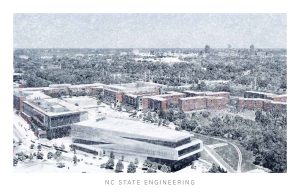
Engineering has a large footprint on the campus. When Engineering Building III is completed next year, a majority of the College’s academic departments will be located at the campus in facilities comparable to the finest in the country. The campus environment, which puts academic buildings in close proximity to companies like ABB and Red Hat (which has its corporate headquarters on the campus) lets students and faculty collaborate with the brightest minds in industry.

“This campus is a tremendously attractive place for the College of Engineering to be a part of,” said Dr. Louis A. Martin-Vega, dean of the College, “and at the same time, we feel that the College of Engineering plays a significant role in attracting other industries and agencies to be a part of it.”

Centennial Campus is about much more than just engineering, but engineering played a huge role in its development. NC State engineers brought people together, found common ground and urged those in power to see the common good of Centennial’s vision. Engineering alumni have helped build the campus, and some even go to work there.

The campus dates to 1984, when Gov. James Hunt allocated 385 rolling acres in west Raleigh to NC State. More land was allocated later, and the University drew up a master plan to develop the property under the direction of Chancellor Bruce Poulton and Claude McKinney, who was dean of the College of Design at the time and later became the campus’ chief planner.

The vision was bold. The campus would have academic and research buildings, but it would also have space for industry and government offices that could provide fruitful partnerships for NC State. Throw in a golf course, a middle school, coffee shops and restaurants, along with apartments for students and faculty, and the new “technopolis” was to set a new standard for university communities across the nation.

“We don’t call it a ‘research park,’” said Dennis Kekas, associate vice chancellor for Centennial Campus partnerships, “and that’s by design.”

Helping to spur the campus’ development was Dr. Larry Monteith, NC State’s dean of engineering from 1978 to 1989. Monteith had been part of a group that helped shaped the concept of Research Triangle Park, and early on in the Centennial planning process he saw the unique opportunity the campus presented. As dean, he envisioned a large engineering graduate research center on the campus, and eventually he began talking to his engineering colleagues about moving the entire College to Centennial.

By the time Monteith took over as chancellor in 1989, NC State had broken ground on its College of Textiles on Centennial, and planning and design of the Engineering Graduate Research Center had been approved. Monteith helped work out a way to bring more third-party tenants to Centennial without the need for state bond referenda, speeding the campus’ development.

A big boost came in 1993, when North Carolina voters approved a bond referendum that included funding for the Engineering Graduate Research Center. When completed four years later, the state-of-the-art multidisciplinary research facility included a three-level art galleria fronted by a brick plaza sitting atop a five-and-a-half-level underground parking garage. Adjoining it was the Constructed Facilities Laboratory, which allows full-scale testing of bridge supports and other large structures.

Appropriately enough, the new research building was eventually renamed the Larry K. Monteith Engineering Research Center.

About Magazine Archives Privacy Accessibility Webmaster